

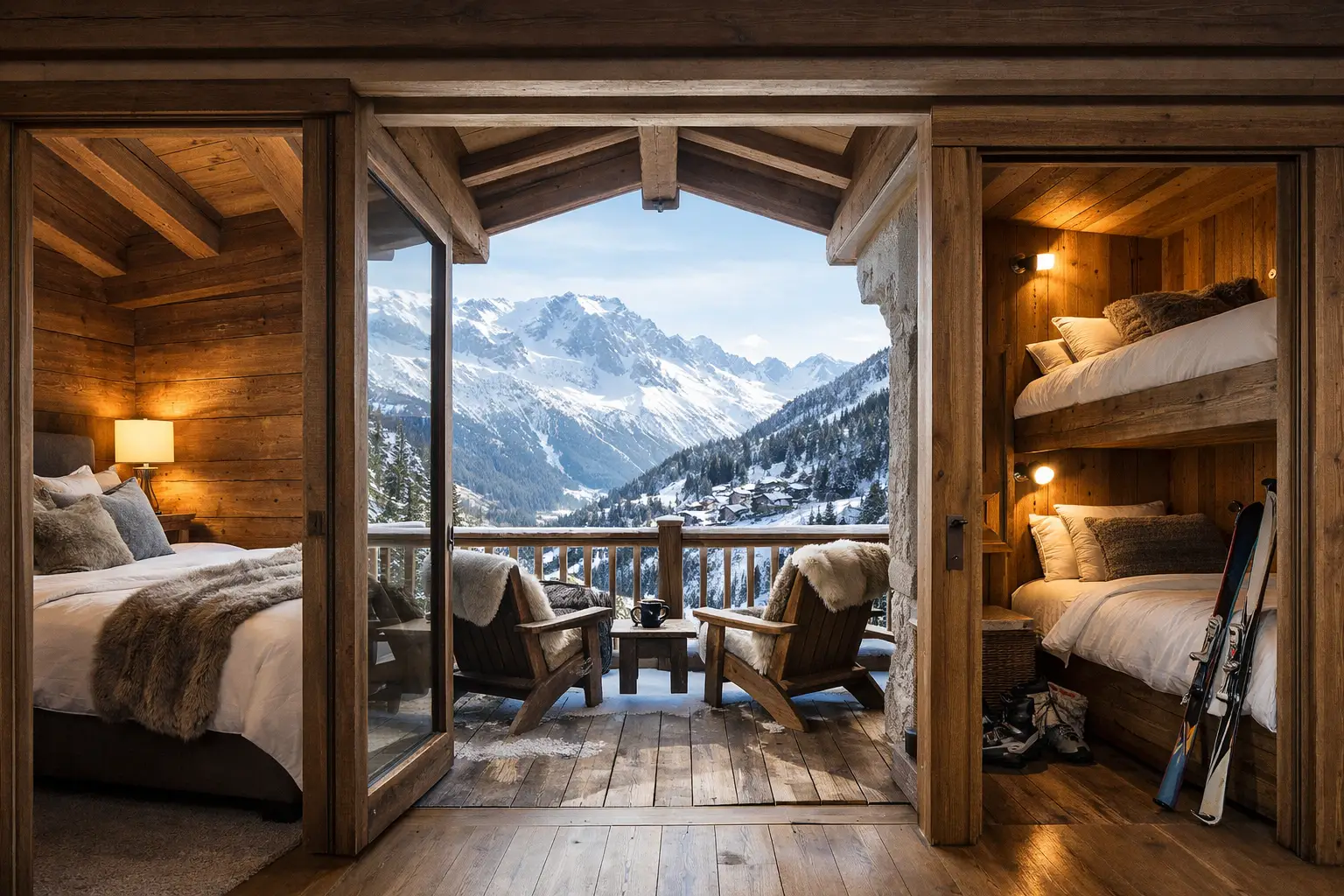
A ski trip starts to feel expensive for the wrong reasons when the bedroom setup is off. One couple ends up beside the utility room, children are split across floors, and the group that imagined long fireside evenings is quietly negotiating bathroom schedules by day two. If you are asking how many bedrooms ski chalet stays should have, the real answer is less about headcount alone and more about how you want the week to feel.
For luxury alpine travel, bedroom count shapes privacy, rhythm, and comfort just as much as square footage or spa amenities. A chalet that technically sleeps everyone can still feel poorly suited to the group. The best choice is usually the one that gives each guest enough personal space while preserving the sense of togetherness that makes a mountain stay memorable.
How many bedrooms ski chalet bookings really need
The simplest rule is to begin with sleeping arrangements, then add one layer of comfort. If you have eight adults traveling as four couples, four bedrooms may work on paper. In practice, five bedrooms often feels more elegant, especially if one room can serve as a flex space for a nanny, teenager, or guest who prefers more privacy.
For multigenerational groups, this matters even more. Grandparents may want a quieter floor. Parents with young children often prefer an adjacent room rather than a bunk setup elsewhere in the chalet. Adult siblings traveling with partners may appreciate equal bedroom quality, rather than one primary suite and several noticeably smaller rooms. In a premium chalet, fairness of layout can be almost as important as the number itself.
That is why a five-bedroom chalet does not simply suit five sleeping zones. It may be the right fit for three couples, two children, and one caregiver. A six-bedroom property may be ideal for ten guests, not because ten people require six rooms, but because the additional bedroom creates breathing room across the stay.
Bedroom count by group type
Different travel groups use chalet space differently. A family holiday has one pattern. A corporate ski week or a friends’ trip has another.
Couples and adult groups
If your group is mainly couples, one bedroom per couple is the obvious baseline. The question becomes whether everyone is equally comfortable with the room categories. In some chalets, one or two suites are exceptional while the remaining rooms are more compact or have twin-bed configurations. That may be perfectly acceptable for a relaxed group of close friends, but less appealing when everyone is contributing at a premium level.
For this reason, adult groups often benefit from one additional bedroom beyond the minimum. It creates flexibility for guests who snore, arrive later, work remotely for part of the week, or simply value more personal space. In the luxury segment, comfort is rarely about squeezing into the right capacity. It is about avoiding compromise.
Families with children
Families can often be more flexible, but only if the layout supports it. Younger children may happily share a bunk room, which can reduce the bedroom count you need. Teenagers usually prefer more separation, and parents often do too.
A four-bedroom chalet can work beautifully for two parents, two children, and grandparents, provided one room is designed for children and another sits close to the primary suite. But if the children’s room is on a lower level near the cinema room while the adults are two floors above, the arrangement may feel less luxurious than expected. When traveling with children, proximity matters as much as the number of rooms.
Multigenerational stays
These groups tend to need more bedrooms than the guest total first suggests. Privacy expectations vary, bedtimes differ, and not everyone wants to share a wall with early-rising children or late-night socializing.
In a multigenerational setting, extra bedrooms can improve the entire experience. They allow grandparents to rest, parents to manage bedtime routines, and younger adults to enjoy the social spaces without feeling they are keeping the whole chalet awake. If your group spans three generations, adding one more bedroom than your minimum is often a smart decision.
Why room layout matters more than raw capacity
Luxury chalet listings often note how many guests a property sleeps, but that number can hide important differences. A chalet that sleeps 12 in six bedrooms is very different from one that sleeps 12 in four bedrooms with bunk spaces and sofa beds. Both may look adequate online. Only one is likely to deliver the sense of ease most discerning travelers expect.
The same applies to en-suite bathrooms, floor plans, and suite quality. A bedroom count sounds straightforward, but chalet comfort is shaped by questions such as whether each room has its own bathroom, whether bedrooms are spread across several levels, and whether any rooms are better suited to children than adults.
This is where premium booking guidance becomes valuable. A well-matched chalet should align not only with your party size but with your group’s social dynamics. If you are celebrating a milestone birthday, equal room quality may be essential. If you are traveling with staff, nannies, or security, a separate bedroom on a lower level may be ideal. If you are planning a festive week with friends, you may prioritize more en-suite doubles over a children’s dormitory.
When to size up
There are moments when booking a chalet with more bedrooms than you strictly need is worth the investment. Peak holiday weeks are one example, since a seven-night stay can feel much longer if the layout is tight. Another is when the chalet is part of the experience rather than simply a base for skiing.
If you expect leisurely breakfasts, private chef dinners, spa afternoons, and long evenings by the fire, the property needs to carry the rhythm of the trip. More bedrooms usually means more generous overall proportions, better separation between sleeping and entertaining zones, and a more graceful flow throughout the home.
Sizing up can also be wise when guests are arriving from different cities or on different schedules. The extra room absorbs changes easily. It can become a quiet office, a retreat for jet-lagged travelers, or a practical buffer if plans shift. For affluent travelers, this kind of flexibility often justifies the higher rate.
When fewer bedrooms still works beautifully
More is not automatically better. If your group is close-knit, your children are young, and the chalet has an exceptional layout, a lower bedroom count can still feel indulgent.
Some smaller luxury chalets are designed with remarkable efficiency. They offer generous suites, excellent communal spaces, and thoughtful privacy despite a compact footprint. For a family of six or two couples traveling with children, a three- or four-bedroom chalet may feel perfectly balanced, especially in a prime ski-in, ski-out location where convenience outweighs the need for additional sleeping areas.
This is especially true if the property offers standout amenities elsewhere. A refined spa, panoramic terrace, dedicated cinema room, or impeccable service model can elevate the stay beyond bedroom numbers alone. The trade-off is simply that everyone should be genuinely comfortable with the arrangement before booking.
Choosing the right bedroom count for a luxury stay
A useful way to decide how many bedrooms ski chalet accommodations should include is to ask three questions. First, who is sharing with whom, realistically, not optimistically? Second, does the layout support your group’s routines, privacy expectations, and age mix? Third, do you want the chalet to accommodate the group or impress the group?
That last question matters. If this is a celebratory week in Courchevel, St. Anton, Zermatt, or Val d’Isere, the chalet is often part of the occasion itself. In that case, extra bedrooms can add a sense of generosity that guests notice immediately. The stay feels less managed, more natural, and far more refined.
At The Chalet Luxe, this is often where the best decisions are made – not at the stage of counting beds, but at the point of matching space to experience. The right chalet should feel composed from the moment guests arrive, with a layout that supports both privacy and effortless gathering.
A good rule of thumb is simple: match the number of bedrooms to your group, then add space if the week includes mixed ages, special occasions, or high expectations for privacy. In alpine luxury, that extra margin is rarely wasted. It is often what turns a beautiful property into an unforgettable experience.
The right chalet should never leave guests negotiating comfort. It should let everyone settle in, spread out, and enjoy the mountains exactly as they came for them.

Join The Discussion